Anyone can claim a hand-vetted network. Fewer can actually show you the process behind it. If you buy links in this niche, you already know the risk: a site looks solid on paper, then the placement disappears six weeks later. Learning how to vet iGaming publishers properly is the only real defense against that outcome.
This guide walks through a repeatable framework you can apply before greenlighting any placement, whether you run the checks yourself or hand them off to a partner. The goal is simple: know exactly how to vet iGaming publishers before money changes hands, not after a link disappears.
Why Publisher Vetting Cannot Be Skipped
Gambling-adjacent SEO draws extra scrutiny from search engines, and the inventory itself is less stable than in most niches. A marketplace that skips vetting is really just reselling other people's guesses. When you vet iGaming publishers before spending a single dollar, you remove most of the guesswork: you know who owns the site, whether the traffic is real, and whether the placement will still be live next quarter.
Skip this step and budgets quietly disappear into PBNs, abandoned blogs, and sites that never planned to keep a casino backlink live past the invoice.
Skip the risky publishers
Order guest posts and link insertions on hand-vetted iGaming sites — placed, checked and confirmed live.
Step 1: Confirm Real Ownership
Every legitimate vetting process starts with a simple question: who actually runs this site? Anonymous ownership is a red flag, not a neutral detail. If a link breaks or an editor changes course, you need someone reachable, not a support ticket that goes nowhere.
Publishers willing to be identified tend to protect their placements more carefully, since their own reputation is tied to the outcome. This one check alone filters out a surprising share of low-quality inventory before you even look at traffic.
Step 2: Audit Traffic for Authenticity
Domain metrics can be faked. Genuine visitor behavior is harder to manufacture. Part of any serious approach to vet iGaming publishers involves checking where the traffic actually comes from. A UK-focused betting blog pulling most of its visitors from unrelated regions isn't delivering what it claims.
Look for:
- Organic traffic concentrated in the markets the site says it serves
- Consistent visit patterns over time, not sudden unexplained spikes
- A traffic mix that matches the site's stated niche and language
Step 3: Assess Editorial Content Quality
Thin or purely sponsored content undermines everything else in a vetting checklist. Ask a blunt question about each candidate: would this content be worth reading if nobody paid to publish it? If the last twenty posts are all paid placements, the answer is usually no.
Sites with a real editorial voice, a consistent publishing rhythm, and genuine reader value tend to hold their rankings longer, which protects the links sitting on them.
Step 4: Review Outbound Link Patterns
A homepage can look clean while the article pages underneath are quietly saturated with outbound links. Reviewing pages individually, not just the domain as a whole, is essential when you vet iGaming publishers at scale. Pages that link out excessively pass very little authority, and often signal a site built purely to sell placements.
Watch for:
- Articles with an unusually high number of outbound links per page
- Link neighborhoods dominated by unrelated or low-quality niches
- Inconsistent link density between the homepage and interior pages
Step 5: Confirm the Publisher Accepts iGaming Content
Reluctant publishers are unstable publishers. If a site only tolerates gambling content quietly, that arrangement tends to end the moment an editor changes or a policy shifts internally. Written, upfront consent to iGaming content is one of the strongest predictors of a placement staying live.
This step matters more than it sounds. Buyers who skip it often find their gambling backlinks removed months later without warning, simply because the arrangement was never formalized.
Step 6: Verify Indexation and Visibility
A placement on a deindexed or crawl-blocked page delivers nothing, no matter how good the surrounding metrics look. Before trusting any inventory, confirm that search engines can actually see and index the page in question. It's a fast check, but it's frequently the one people forget.
What Buyers Gain From a Vetted Marketplace
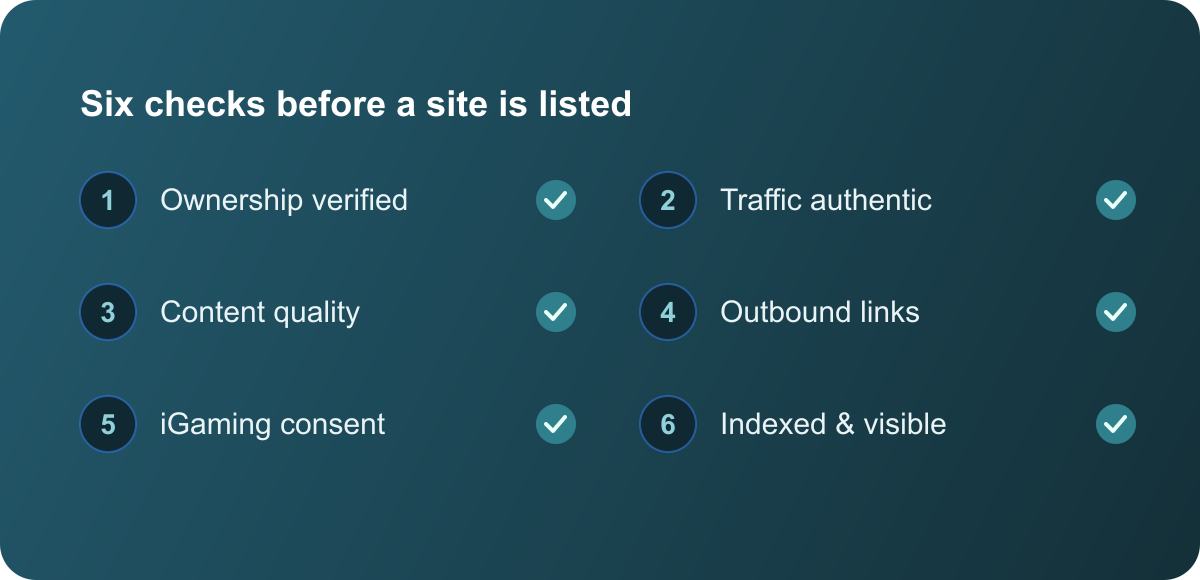
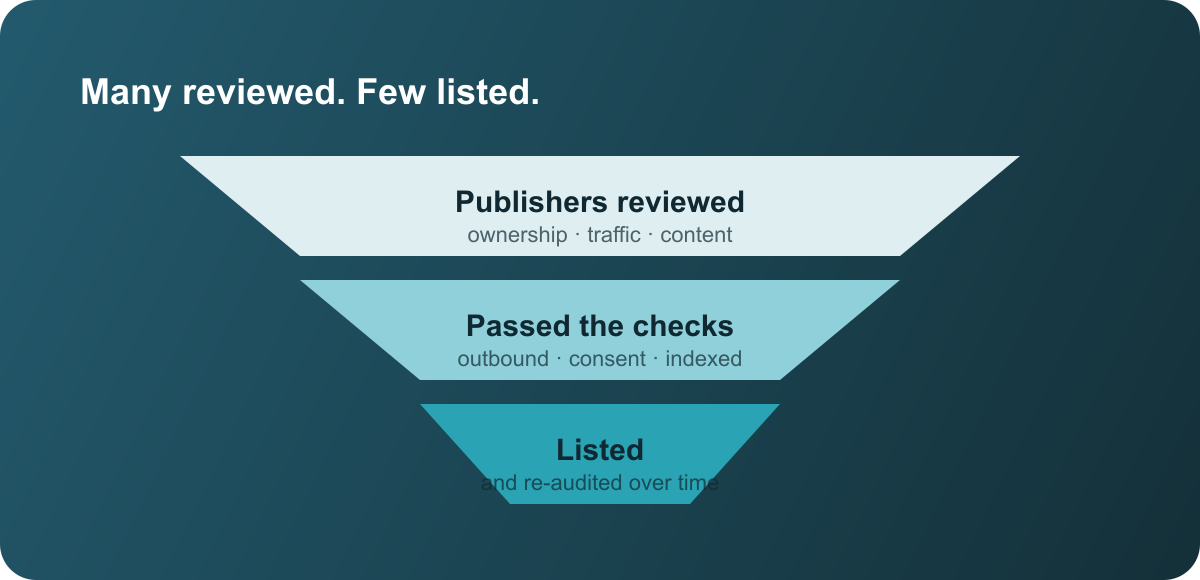
Buyers working with an agency or marketplace that already knows how to vet iGaming publishers save themselves weeks of manual research. Instead of chasing spreadsheets full of unverified domains, they get a shortlist of sites that have already cleared ownership, traffic, content, link, consent, and indexation checks.
This matters most for teams running iGaming SEO campaigns at volume, where dozens of placements can go live in a single month. Without a standardized process to vet iGaming publishers, quality control becomes almost impossible to maintain across that many sites, and a handful of weak placements can quietly drag down an otherwise solid backlink profile.
A Repeatable Vetting Checklist
Turning this process into a written checklist keeps standards consistent across every publisher, not just the first few you review carefully. A workable checklist to vet iGaming publishers typically covers:
- Ownership identity and direct contact information
- Traffic source, volume, and geographic match
- Editorial quality across recent posts, not just the homepage
- Outbound link density on individual article pages
- Written consent for gambling and betting content
- Confirmed indexation status in search engines
Running through this list before every placement turns publisher vetting from a one-off judgment call into a consistent, defensible process.
Common Vetting Mistakes to Avoid
Even experienced buyers cut corners under deadline pressure. A few patterns show up again and again:
- Trusting domain authority scores without checking real traffic behavior
- Approving a site based on the homepage alone, ignoring interior pages
- Skipping written consent and assuming a publisher is comfortable with gambling content
- Treating a one-time approval as permanent instead of re-checking periodically
Each of these shortcuts trades a small amount of upfront effort for a much bigger risk later: links that vanish, rankings that stall, budget spent on inventory that never delivers.
None of these mistakes are exotic. They happen because vetting takes time, and time feels expensive when a campaign deadline is looming. But the maths rarely works out in the buyer's favor: replacing a dead link, chasing a refund, or rebuilding a damaged link profile almost always costs more than the extra hour spent checking a publisher properly upfront.
Re-Vetting Is Not Optional
A publisher that passes today won't necessarily pass in six months. Editorial teams change, ownership shifts, and traffic patterns move. Sites should be re-audited on a rolling schedule, with anything that has slipped on traffic, content, or link hygiene pulled from active rotation.
This ongoing discipline is what separates a marketplace that vets iGaming publishers once from one that maintains standards over time. Buyers benefit either way, but the second approach is the only one that keeps existing placements reliable rather than just the initial batch.
Applying This Framework to Your Own iGaming Link Building
Whether you manage outreach internally or work with a partner, the same six checks apply. A disciplined approach to iGaming link building depends less on volume and more on consistency: the same standards applied to every publisher, every time, with no exceptions for sites that look impressive on the surface.
Buyers focused on casino backlinks and sports betting placements specifically should treat this checklist as a minimum bar, not an optional extra. The publishers worth paying for are the ones that would pass every step above without special pleading.
The Bottom Line
There is no shortcut that replaces a human actually looking at ownership records, traffic sources, content quality, outbound links, written consent, and indexation status. Any process built to vet iGaming publishers properly will slow the buying decision down slightly and save considerably more in wasted spend and disappeared links down the line.
Treat vetting as infrastructure, not paperwork. The publishers that pass a real checklist are the ones that keep your placements live, your rankings stable, and your budget working the way it was supposed to in the first place.
Last updated 14 September 2026.
vettingpublishersquality